
Three contractors walk the same older roof and return three different numbers. The spread can reach several thousand dollars even when the shingle type looks similar. Homeowners often assume the difference is mainly profit margin or sales approach. In most of the files I reviewed, the real drivers were more concrete: different assumptions about decking, different treatment of flashings and valleys, different ventilation plans, and different ways of handling conditions that cannot be fully seen until the old covering is removed.
I’m Heath Bannister. For more than a decade I examined residential claims and contractor estimates on houses built from the 1950s through the early 1980s. Large quote gaps appeared regularly. The lower number was rarely a pure bargain, and the higher number was rarely pure padding. Each proposal usually reflected a different set of expectations about what the job would actually require once work began.
Understanding those expectations is the most practical way to interpret the spread and to decide which number is more realistic for a given house.
Decking Assumptions Drive the Largest Differences
Decking condition is the single biggest source of variation on older homes. One contractor may include a modest allowance for replacement boards. Another may use a higher allowance. A third may list only a per-sheet price and leave the quantity open. A fourth may say little about decking at all.
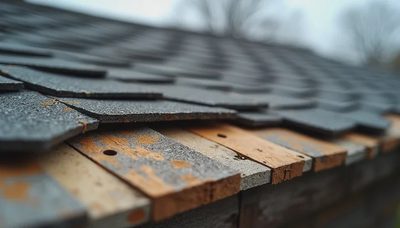
These choices produce very different bottom lines. A low allowance keeps the initial number attractive but creates a high likelihood of change orders. A higher allowance or a clearly stated per-sheet price raises the starting number yet reduces later surprise. When the existing decking is original board sheathing or has already been through multiple roofing cycles, the quantity of replacement can climb quickly once the shingles are gone.
I saw the same pattern repeatedly. The quotes that looked farthest apart on paper often became closer once the actual decking work was measured. The initial gap was largely an artifact of how much uncertainty each contractor chose to absorb in the original number.
Flashing and Valley Scope Create Quiet Gaps
Flashings and valleys are another frequent source of divergence. Some proposals assume existing step flashing and chimney metal can be reused. Others specify full replacement. Some treat valleys as a standard detail; others upgrade the underlayment and metal work. On older homes the existing flashings are often original or have been maintained with repeated sealant. Reusing them carries risk. Replacing them adds cost.
Because these items are not always visible in the same way as the shingle field, contractors can make different judgment calls without the difference being obvious in a quick comparison of totals. A proposal that already includes full flashing replacement will usually sit higher than one that plans to reuse what is there. The lower number may still be valid if the existing metal proves serviceable, but the homeowner will not know that until the roof is open.
Valleys deserve special attention. Water volume is higher, and older valley details frequently show wear earlier than the open field. A scope that upgrades valley protection will carry a higher number than one that matches the previous arrangement. Both approaches can be defended; they are simply different bets about long-term performance.

Ventilation Plans Are Easy to Under-Price
Many older attics were built with limited intake and exhaust. When a new roof is installed, contractors differ on how much improvement to include. One proposal may simply match the existing ridge vent and soffit arrangement. Another may add continuous ridge vent, improve intake, or install baffles to keep insulation from blocking airflow. These upgrades improve the environment for the new shingles. They also add labor and material.
Because ventilation work is less visible than the shingle surface, it is easy for it to be treated as optional or to be omitted from the initial number. The result is another source of gap between quotes that otherwise look similar. Homeowners who ask each contractor to describe the ventilation plan in writing can see the difference clearly.
Hidden Conditions and Contingency Approaches
Some gaps come from how contractors handle uncertainty itself. Older roofs can conceal soft decking, prior repair layers, brittle plumbing boots, or fascia that has absorbed moisture. One contractor may build a larger contingency into the base number. Another may keep the base number lean and rely on change orders. A third may list unit prices for the most common extras so the homeowner can see the potential exposure in advance.
None of these methods is automatically wrong. They do produce different starting prices. The lean number looks better on day one and carries more risk of later increases. The higher number looks less competitive at first and often finishes closer to the original figure. The unit-price approach sits in between and gives the homeowner more visibility.
When I compared estimates side by side, I paid more attention to how each one treated uncertainty than to the raw total. The method revealed more about the likely final cost than the initial ranking did.
Material Specifications and Labor Assumptions
Even when the shingle brand appears the same, the supporting materials can differ. Underlayment type, ice-and-water shield coverage, nail type and pattern, and starter course details all affect both price and performance. Labor assumptions also vary. Some crews price for a faster production pace; others build in more time for careful flashing work and site protection on a complicated older roof.
These differences are harder to spot without reading the full scope. Two proposals can list the same shingle and still rest on different underlayment, different flashing practices, and different expectations about daily production. The resulting numbers diverge even though the most visible product looks identical.
How to Read the Gap Instead of Reacting to It
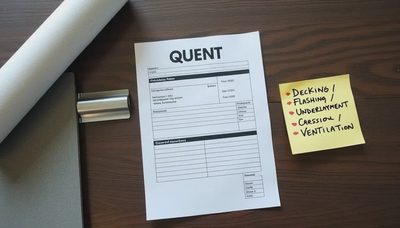
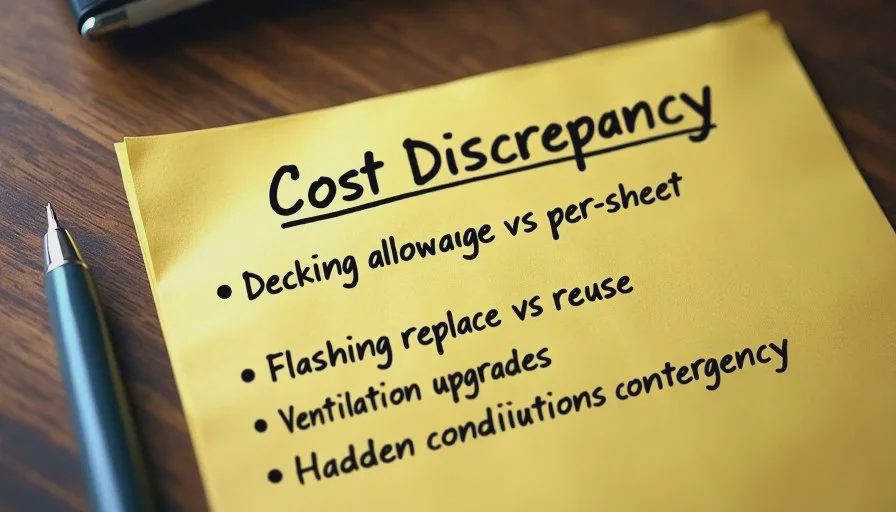
When the quotes arrive, resist the urge to rank them solely by total price. Create a simple side-by-side list that captures the main variables:
Decking policy (allowance amount, per-sheet price, or silence)
Flashing and valley treatment (replace, reuse, or evaluate later)
Ventilation plan (match existing or improve)
Handling of common extras (unit prices, contingency, or change orders)
Specificity of underlayment and ice-and-water shield
Fill in what each proposal actually says. The finished comparison usually shows that the numerical gap is the result of different choices rather than arbitrary markup. A higher number that already answers the major questions may be more realistic than a lower number that leaves those questions open.
Ask every contractor the same clarifying questions and write the answers next to each quote. Useful questions include:
How do you determine which decking boards to replace, and how is that work priced?
Will step flashing and chimney counter flashing be replaced as part of this number?
What exactly is included for valleys?
What ventilation improvements, if any, are in this proposal?
How will additional work be priced and approved if soft decking or other issues appear?
The answers turn an opaque spread into a set of understandable trade-offs.
Why Older Homes Produce Wider Gaps
Newer houses tend to present more uniform conditions once the covering is removed. Older houses carry the cumulative record of previous roofing cycles, original construction methods, and years of weather. Decking thickness and attachment, flashing integration, and attic airflow frequently differ from current practice. Contractors who have learned to expect those differences build them into the number in different ways. The result is a wider spread than the same roof would produce on a house built ten years ago.
That wider spread is not evidence that someone is overcharging. It is evidence that the structure contains more variables. The practical response is to make those variables visible in the comparison rather than to assume the lowest number is the most efficient choice.
Closing the Interpretation Gap
Large differences between roofing quotes on older homes are rarely random. They usually reflect different assumptions about decking quantity, flashing scope, ventilation upgrades, and the treatment of conditions that remain hidden until tear-off. Reading the proposals against those factors turns the spread from a source of confusion into a source of information.
The goal is not to eliminate every difference. The goal is to understand which differences matter for the specific house and to choose the scope that most accurately matches the conditions that are likely to appear. When that alignment is clear, the final cost is easier to accept—whether it started as the middle number, the higher number, or the one that looked least attractive on the first reading.