A roofing quote can look clean and still leave important questions unanswered. On an older home those unanswered questions often turn into change orders, incomplete work, or arguments about what was supposed to be included. After more than a decade reviewing residential estimates and claims, I developed a short list of patterns that make me pause. None of them proves that a contractor will do poor work. Each of them increases the chance that the job will become more expensive or more contentious than the original number suggested.
I’m Heath Bannister. Most of the roofs I examined sat on houses built between the 1950s and the early 1980s. The proposals that produced the fewest later surprises were usually the ones that already addressed the variables older houses tend to raise. The proposals that produced the most friction were often the ones that looked simple on the surface and left the difficult decisions for later. The eight items below are the patterns I learned to treat as caution signals.
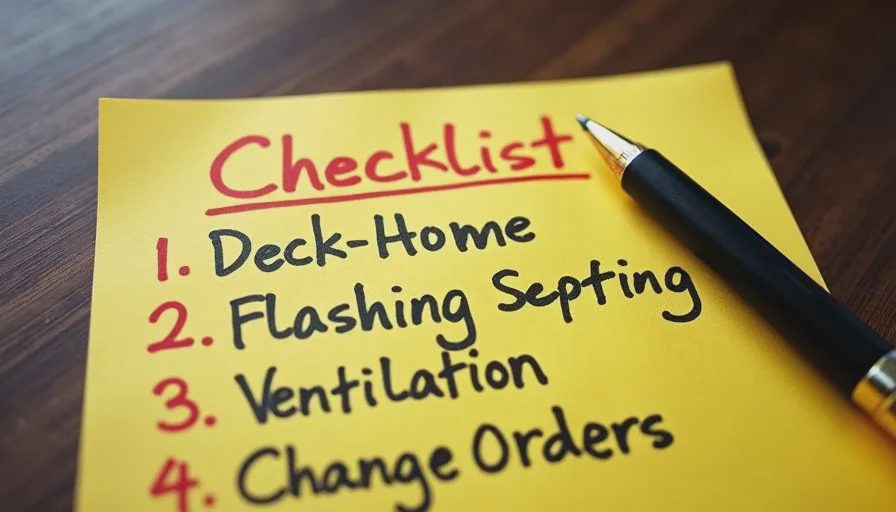
1. Decking Language That Says Almost Nothing
Decking is the largest source of cost variation on older homes. A quote that remains silent on the subject, or that uses vague phrases such as “replace as needed,” leaves the largest variable undefined. Useful language states either a clear allowance or a per-sheet price paired with the criteria that will be used to decide which boards are replaced.
When the proposal offers neither, the homeowner has no shared reference once the old shingles come off. Soft or previously damaged decking is common on houses that have already been through multiple roofing cycles. Leaving the decision and the pricing completely open is one of the most reliable ways to create later disagreement.
2. Flashings Treated as Optional or Unmentioned
Step flashing, chimney counter flashing, and valley details are not trim. They are the components that keep water out at every transition. On older homes these elements are frequently original or have been maintained with repeated sealant. A quote that assumes they can be reused without inspection, or that does not mention them at all, is incomplete.
I looked for explicit statements: will the flashings be replaced, reused, or evaluated during tear-off? Silence on the point is itself information. It usually means the decision will be made under time pressure once the roof is open.
3. Ventilation Left at “Existing Conditions”
Many older attics were built with limited airflow. Simply installing new shingles over the same restricted intake and exhaust shortens the life of the new roof. A proposal that says nothing about ventilation, or that states the existing system will remain unchanged without any evaluation, leaves a known performance factor unaddressed.
Clearer proposals describe what will be done with the ridge, the eaves, and any existing vents. They also note whether baffles or other measures will be used to keep insulation from blocking airflow. When those details are missing, the quote is pricing a surface replacement rather than a roof system that can actually breathe.
4. Underlayment and Ice-and-Water Shield Described Only as “Standard”
Underlayment is the secondary barrier beneath the shingles. Ice-and-water shield provides extra protection at eaves, valleys, and penetrations. Using the word “standard” without naming the product or the coverage locations makes comparison difficult and verification later almost impossible.
On older homes that have already shown vulnerability at those locations, the extent of ice-and-water shield can matter as much as the shingle choice. A quote that leaves both the product and the locations unspecified is harder to evaluate and harder to enforce.
5. No Written Process for Change Orders
Even careful scopes encounter unexpected conditions on older houses. What separates manageable jobs from contentious ones is often the presence of a clear change-order process. The proposal should state how additional work will be priced, how the homeowner will be notified, and whether written approval is required before the extra work proceeds.
Absence of any such language means the conversation about extras will occur without agreed ground rules. On a job that is already under way, that conversation is rarely comfortable.
6. Warranty Terms That Stay Vague
Manufacturer material warranties and contractor workmanship warranties are different instruments. A quote that simply says “warranty included” or “transferable warranty” without numbers or conditions gives the homeowner little protection if questions arise later.
Useful language states the length of the workmanship coverage, whether it is transferable, and any maintenance requirements that apply. It also distinguishes the manufacturer’s terms from the contractor’s own obligation. Vague warranty language is common; specific language is more useful.
7. Cleanup, Site Protection, and Final Walkthrough Omitted
These items rarely dominate the cost, yet their absence from the written scope is a frequent source of disappointment. Roofing work produces nails, granules, and debris. Landscaping and adjacent surfaces need protection. A final walkthrough gives both parties a chance to note punch-list items while the crew is still available.
When the proposal is silent on these points, the homeowner has little basis for expecting them. Including them in the scope does not guarantee perfect execution, but it does make the expectations visible before work begins.
8. A Price That Sits Far Below the Other Bids Without Explanation
A lower number is not automatically a problem. A lower number that is not accompanied by a clearer or more limited scope is worth examining closely. On older homes the difference between a low bid and a mid-range bid is often explained by what has been left out—decking assumptions, flashing treatment, ventilation, or contingency for hidden conditions.
When one proposal is substantially lower than the others and the written scope does not show corresponding reductions in work, the gap itself becomes a red flag. The missing cost will usually reappear later as change orders or as work that was never performed.
How to Use the List
None of these eight items is a reason to reject a contractor on sight. Each is a reason to ask a clarifying question and to get the answer in writing. The strongest response to a red flag is a short, specific follow-up:
“Can you state the per-sheet decking price and the criteria you use?”
“Will step flashing and chimney flashing be replaced as part of this number?”
“What exactly is included for ventilation?”
“How will change orders be priced and approved?”
The replies turn an incomplete proposal into a clearer one, or they confirm that the gaps will remain. Either outcome is more useful than discovering the same gaps after the tear-off has begun.
Why Older Homes Surface These Issues More Often
Newer houses tend to present more uniform conditions once the covering is removed. Older houses carry the cumulative record of previous roofing cycles, original construction practices, and years of weather. Decking, flashings, and attic airflow frequently differ from current standards. Quotes that do not anticipate those differences leave more decisions unstated. The red flags above are simply the most common ways those unstated decisions appear on paper.
Closing the Review
A clean-looking quote is not always a complete quote. On an older home the difference between the two is often visible in the treatment of decking, flashings, ventilation, change orders, and the other items on this list. Reading the proposal against these eight points takes only a few minutes. The clarity it produces can save months of later friction.
Ask the questions. Get the answers in writing. Choose the scope that already addresses the variables the house is most likely to raise. That sequence remains one of the most reliable ways to keep an old-house roof job under control from the first day to the last.