
A roofing bid on an older home is only as useful as the assumptions behind it. When those assumptions stay unspoken, the lowest number can become the most expensive once the old shingles come off. The simplest way to bring the assumptions into the open is to ask the same set of direct questions of every contractor and to write the answers down.
I’m Heath Bannister. After more than a decade reviewing residential claims and contractor estimates, I watched the same gaps appear in proposal after proposal. Decking policy was vague. Flashing treatment was left unstated. Ventilation was assumed rather than planned. Change-order terms were missing. The homeowners who avoided the largest surprises were usually the ones who asked clearer questions before anyone started work.
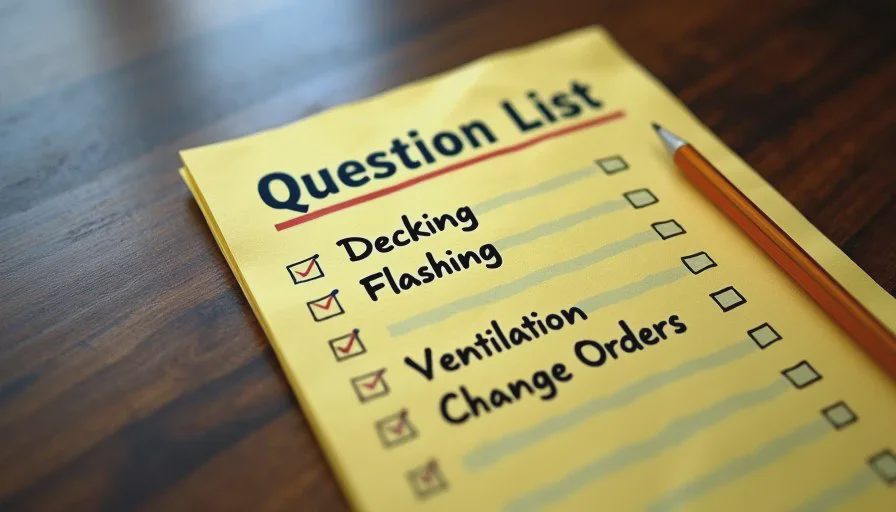
The list below is the set of questions I consider most useful when the house is older and the existing roof has already lived through several decades of weather and previous repairs.
Questions About Decking
Decking condition is the largest source of cost variation on older homes. The questions need to be specific.
How will you decide which decking boards or panels need replacement?
What is the per-sheet or per-board price for replacement?
Is any allowance for decking already included in the quoted number?
How will I be notified, and how will approval work, if the quantity exceeds what was expected?
Vague answers such as “we’ll replace what’s bad” leave too much room for later disagreement. Written unit prices and a clear decision standard give both sides a shared reference once the roof is open.
Questions About Flashings and Valleys
Flashings are where many older roofs first lose reliability. The scope should not treat them as afterthoughts.
Will all step flashing along sidewalls be replaced, or will some existing metal be reused?
How will chimney counter flashing be handled?
What is the plan for valleys—new metal, woven shingles, or another detail?
Are plumbing boots and other penetration collars included as new items?
On older homes the existing flashings are often original or have been maintained with repeated sealant. A contractor who plans to reuse them should be able to explain why that is still appropriate. A contractor who plans to replace them should have that work visible in the number.

Questions About Underlayment and Ice-and-Water Shield
The secondary barrier under the shingles matters more on a roof that has already shown age-related vulnerabilities.
What underlayment product will be used, and where will it be applied?
Where exactly will ice-and-water shield be installed—eaves, valleys, penetrations, or other locations?
Is the underlayment specification written in the proposal?
Generic phrases such as “standard underlayment” make comparison difficult. Product names and coverage locations turn the item into something that can be verified.
Questions About Ventilation
Many older attics were built with limited airflow. A new roof installed over the same restricted ventilation simply inherits the previous problem.
What is the plan for ridge ventilation and intake at the eaves?
Will any existing vents be modified or replaced?
Are baffles or other measures included to keep insulation from blocking airflow?
Does the current proposal improve ventilation or simply match what is already there?
If the answer is that the existing ventilation is considered adequate, that judgment should be stated so it can be evaluated against what is visible in the attic.
Questions About the Scope Boundaries
Clarity about what is included and excluded prevents most later friction.
Does the price include full tear-off to the deck, or will any layers remain?
How will fascia, drip edge, and gutter interfaces be handled?
What site-protection and cleanup measures are included?
Is a final walkthrough with me part of the process?
These items rarely dominate the cost, yet their absence from the written scope is a common source of disappointment once the crew leaves.
Questions About Change Orders and Communication
Even a careful scope cannot eliminate every surprise on an older house. What it can do is define how surprises will be managed.
How will additional work be priced if unexpected conditions appear?
Will I receive a written change order before extra work proceeds?
Who will be the on-site lead, and how should day-to-day questions be directed?
What is the expected timeline, and how will weather delays be communicated?
Clear process language is often more valuable than optimistic schedule promises.
Questions About Insurance, Licensing, and Warranty
These questions protect the homeowner regardless of the age of the house, but they remain essential.
Can you provide current proof of liability insurance and workers’ compensation coverage?
Are you licensed where this work requires it?
What is the length of your workmanship warranty, and is it transferable?
How does the manufacturer’s material warranty interact with your workmanship coverage?
Written proof is more useful than verbal assurance. Warranty terms should be stated in numbers and conditions rather than in general claims of coverage.
How to Use the Answers
Ask the same questions of every contractor and record the replies in a simple side-by-side format. The resulting comparison usually reveals more than the raw totals. One proposal may carry a higher number because it already includes full flashing replacement and a realistic decking approach. Another may look lower because those items remain open. A third may give precise unit prices while a fourth remains general. Those differences become visible only when the answers are written down next to each other.
I used to rewrite scopes on a yellow legal pad in plain language precisely to expose these gaps. Homeowners can do the same with far less effort by using a consistent question list.
Why Older Homes Require This Level of Clarity
Newer houses tend to present more predictable conditions once the covering is removed. Older houses carry the cumulative effects of previous roofing cycles, original construction practices, and years of weather. Decking thickness and attachment, flashing integration, and attic airflow frequently differ from current standards. Contractors who have learned to expect those differences will answer the questions with more specificity. Contractors who have not will leave more of the decisions for later.
The questions themselves do not guarantee perfect work. They do force the important variables into the open before the contract is signed. On an older home that step is one of the highest-leverage actions a homeowner can take.
A Short Practical Sequence
Before the first contractor arrives, walk the exterior and the attic and note the conditions you already see. When each proposal is presented, work through the question list and write the answers down. Compare the completed answers side by side before ranking the totals. Clarify any remaining blanks in writing. Only then decide which scope most accurately matches the house.
The roof decision becomes clearer when it rests on documented answers rather than on which number first sounded reasonable. Asking the questions is straightforward. Insisting on clear replies is what turns a set of bids into a usable comparison.