

A roofing quote that only lists a total price and a few material names leaves too many decisions unstated. On an older home those unstated decisions often become change orders once the old shingles come off. A useful scope of work reduces that risk by putting the important details in writing before any contract is signed.
I’m Heath Bannister. After more than a decade reviewing residential claims and contractor estimates, I saw the same gaps appear repeatedly. Proposals that looked complete on the surface omitted how decking would be handled, whether flashings would be replaced, what underlayment would be used, and how additional work would be priced. The homeowners who avoided the largest surprises were usually the ones who insisted on clearer language up front.
This article lists the elements I consider essential in a roofing scope, especially when the house is older and the existing roof has already lived through several decades of weather and previous repairs.
Start With a Clear Description of the Work
The scope should state what is being removed and what is being installed. “Tear off existing roofing to the deck and install a new asphalt shingle roof” is a minimum starting point. Better versions specify whether one layer or multiple layers will be removed, whether the existing underlayment will be stripped, and whether any areas will be left in place. On older homes it is common to find more than one layer of shingles. The scope should address that possibility directly rather than leaving it for later discovery.
The same section should name the new materials with enough precision to be verifiable. Manufacturer and product line for the shingles, type and thickness of underlayment, and the style of ridge vent or other ventilation components all belong in writing. Generic phrases such as “quality shingles” or “standard underlayment” give the homeowner little basis for comparison or later discussion.
Decking Policy Must Be Explicit
Decking condition is the largest source of cost variation on older houses. A scope that remains silent on this point creates unnecessary risk. Useful language takes one of two forms: a stated allowance for replacement boards, or a clear per-sheet price paired with the criteria that will be used to decide which boards need replacement.
I preferred the second approach when I reviewed estimates. An allowance that is set too low simply defers the conversation until the crew is on site. A per-sheet price with written decision standards lets the homeowner understand the potential exposure in advance. The scope should also state who makes the final call on questionable boards and how the homeowner will be notified before additional work proceeds.
Flashing and Penetration Details Belong in the Scope
Flashings are not minor trim. They are the details that keep water out at every joint and penetration. The scope should state whether step flashing along sidewalls will be replaced, whether chimney counter flashing will be renewed, and how valleys will be treated. On older homes these components are frequently original or have been repaired with sealant. Assuming they can be reused without inspection is a common source of later disagreement.
Plumbing boots, electrical mast collars, and other penetrations should also be addressed. Many of these items become brittle with age and are best replaced while the roof is open. A scope that lists them as included prevents the surprise of discovering they were left out of the original number.

Underlayment and Ice-and-Water Shield Locations
Underlayment is the secondary barrier beneath the shingles. The scope should name the product and state where ice-and-water shield will be applied. Common locations include eaves, valleys, and around penetrations. On older homes in colder climates, the extent of ice-and-water shield can affect both performance and price. Leaving these decisions unstated means they will be made later, often under time pressure.
Ventilation Plan
Many older attics were built with limited airflow. A new roof installed over the same restricted ventilation will age faster than necessary. The scope should describe what will be done with existing vents and whether any improvements are included. Ridge vent length, soffit intake, and the use of baffles to keep insulation clear of the eaves are all relevant details. If the proposal assumes the existing ventilation is adequate, that assumption should be written down so it can be evaluated.
Workmanship, Cleanup, and Site Protection
A complete scope also covers how the work will be performed. Statements about protecting landscaping, covering openings, daily cleanup, and final magnet sweep for nails belong in the document. These items rarely change the structural performance of the roof, yet they affect the homeowner’s experience and the condition of the property when the crew leaves. Their presence in the scope signals that the contractor has thought through the full job rather than only the roofing surface.
Change-Order Process
Even the most careful scope cannot eliminate every surprise on an older house. What it can do is define how surprises will be handled. The document should state how additional work will be priced, how the homeowner will be notified, and whether written approval is required before the extra work proceeds. Clear change-order language reduces the chance of later disputes about both cost and authorization.
Warranty Terms Separated by Type
Manufacturer material warranties and contractor workmanship warranties are different instruments. The scope or the accompanying contract should state the length of each, whether the workmanship coverage is transferable, and any maintenance conditions that apply. Vague references to “a transferable warranty” without numbers or conditions give the homeowner little protection if questions arise years later.
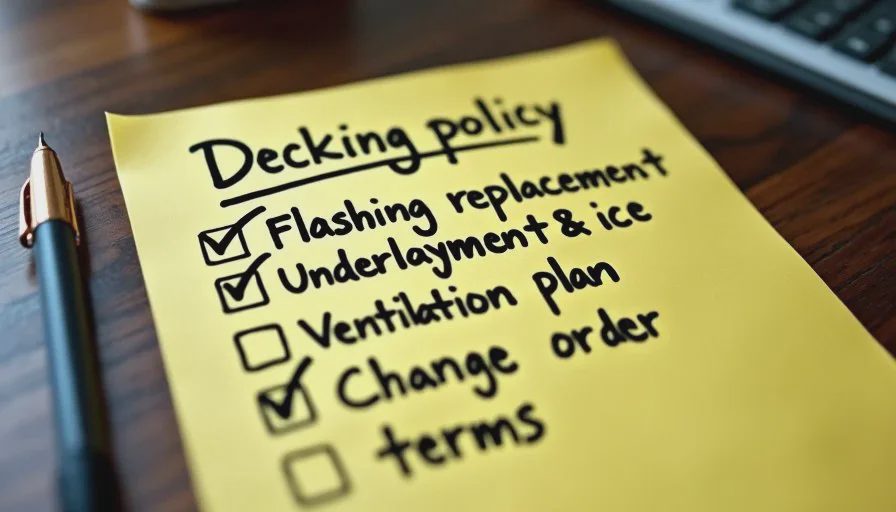
A Practical Checklist Before Signing
When the proposal arrives, read it against a short list of questions:
Does it state what will be removed and what will be installed, with product names?
Is the decking policy clear—allowance or per-sheet price plus decision criteria?
Are flashings, valleys, and penetrations addressed as included or excluded?
Are underlayment type and ice-and-water shield locations specified?
Is there a written ventilation plan?
Are cleanup, site protection, and final walkthrough mentioned?
Is the change-order process defined?
Are material and workmanship warranties stated separately with terms?
Any blank answer is a point to clarify in writing before the contract is signed. The goal is not to demand perfection. The goal is to move the important decisions out of the “we’ll see when we get into it” category and into the written agreement.
Why This Matters More on Older Homes
Newer houses often present more predictable conditions once the covering is removed. Older houses carry the cumulative effects of previous roofing cycles, original construction practices, and years of weather. Decking thickness, nail patterns, flashing integration, and attic airflow frequently differ from current standards. A scope that anticipates those differences produces fewer difficult conversations once the work is underway.
I rewrote many estimates on a yellow legal pad simply to put the missing pieces into plain language. The exercise usually revealed whether the original document had already answered the necessary questions or had deferred them. Homeowners who performed a similar review for themselves were in a stronger position to compare proposals and to hold the chosen contractor to the terms that had been agreed.
Closing the Gap Between Quote and Reality
A low number attached to a thin scope is not a bargain if the missing items appear later as change orders. A higher number attached to a thorough scope may represent a more accurate picture of the work the house actually needs. The only way to tell the difference is to read the details before the total becomes the main focus.
Insist on written clarity about materials, decking, flashings, ventilation, and the handling of additional work. Those elements turn a price quotation into a usable scope. On an older home, that difference is often the margin between a controlled project and a series of unwelcome surprises.